Urban Design · 2021
Bent Line Park
by Xiaofei Sun
From the psychoanalytic perspective of sexuality, the path of sexual orientation cognition is the necessary path for the awakening of the subject's sexual consciousness and the mirror stage of the human self in Donna Haraway's future anti-utopian cyborg.
Deleuze was the first philosopher to move from schizo analysis into space, but did not spatialize the schizoid sex drive schizo into a space of choice, awakening of sexuality and the subject. BENT LINE PARK addresses this gap through spatial experimentation.
Inspired by the High Line Park, the project materializes historical cognition and attitudes towards LGBT+ people, juxtaposing historical elements in multiple linear spaces for an interlaced narrative. Built on paper as an anti-utopian intervention, it serves as a spiritual commitment to thinking about human cognition and the future recognition of LGBT+ history.
Project Details
Artist
Xiaofei Sun
Year
2021
Medium
Urban Design, Spatial Research, Rhizome Theory
Dimensions
Urban design intervention
Location
Virtual
Artist Statement
Xiaofei Sun is an urban designer whose work engages with spatial theory, social history, and speculative design. Through the lens of critical theory—particularly rhizome theory and psychoanalytic frameworks—his practice investigates how architecture can materialize cognitive processes and make visible the histories of marginalized communities. BENT LINE PARK represents a commitment to design as a form of cultural scholarship and political imagination.
— Xiaofei Sun
Interested in This Work?
For inquiries or more information, please contact:
info.unbriefed@gmail.com
Works
Project Overview
01 / 07
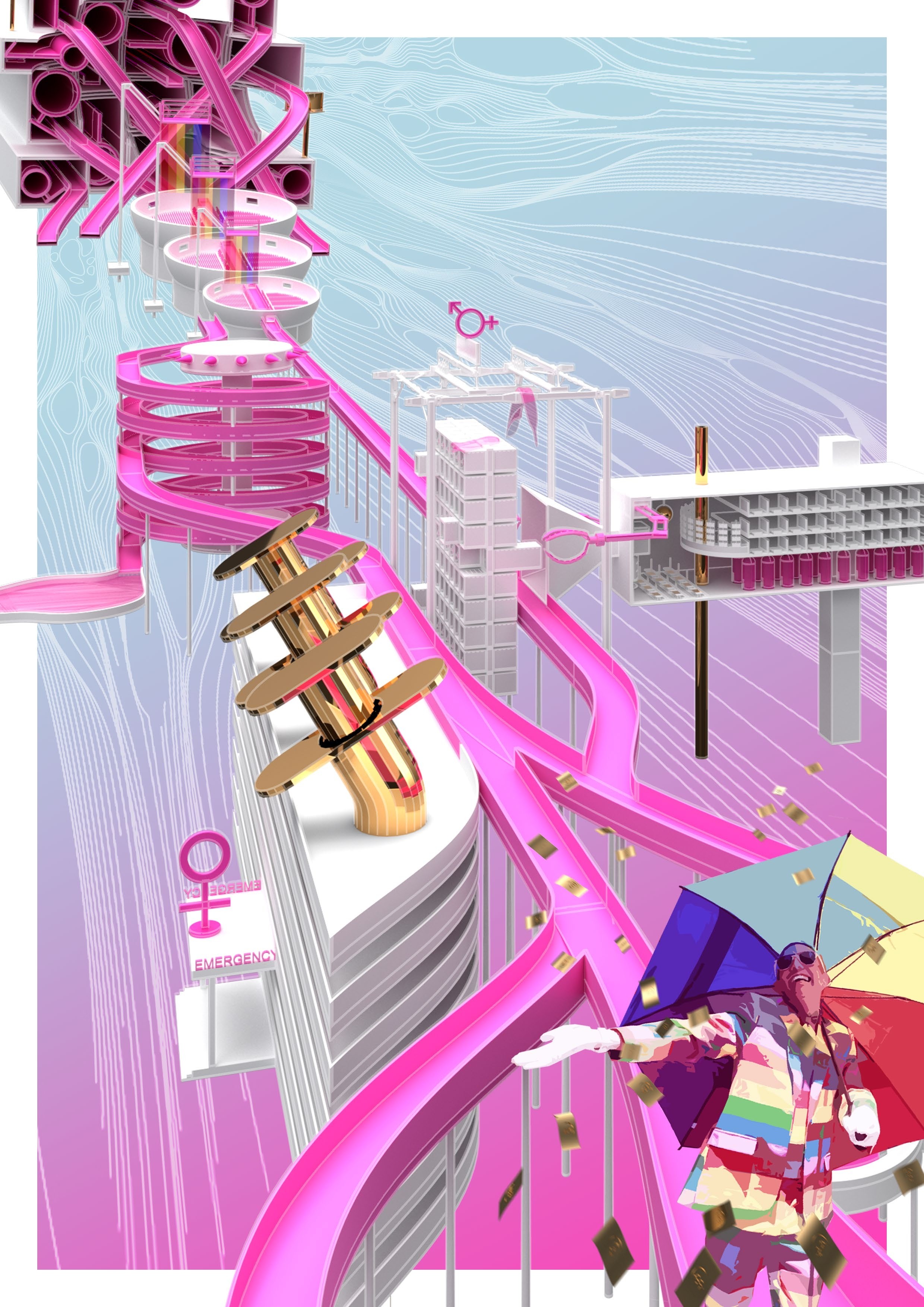
Opening spread introducing Bent Line Park with an axonometric rendering of the vibrant pink infrastructure winding through the urban fabric. The project combines theoretical research with spatial intervention, creating a new typology that bridges history, theory, and public space.
Background & Theory
02 / 07
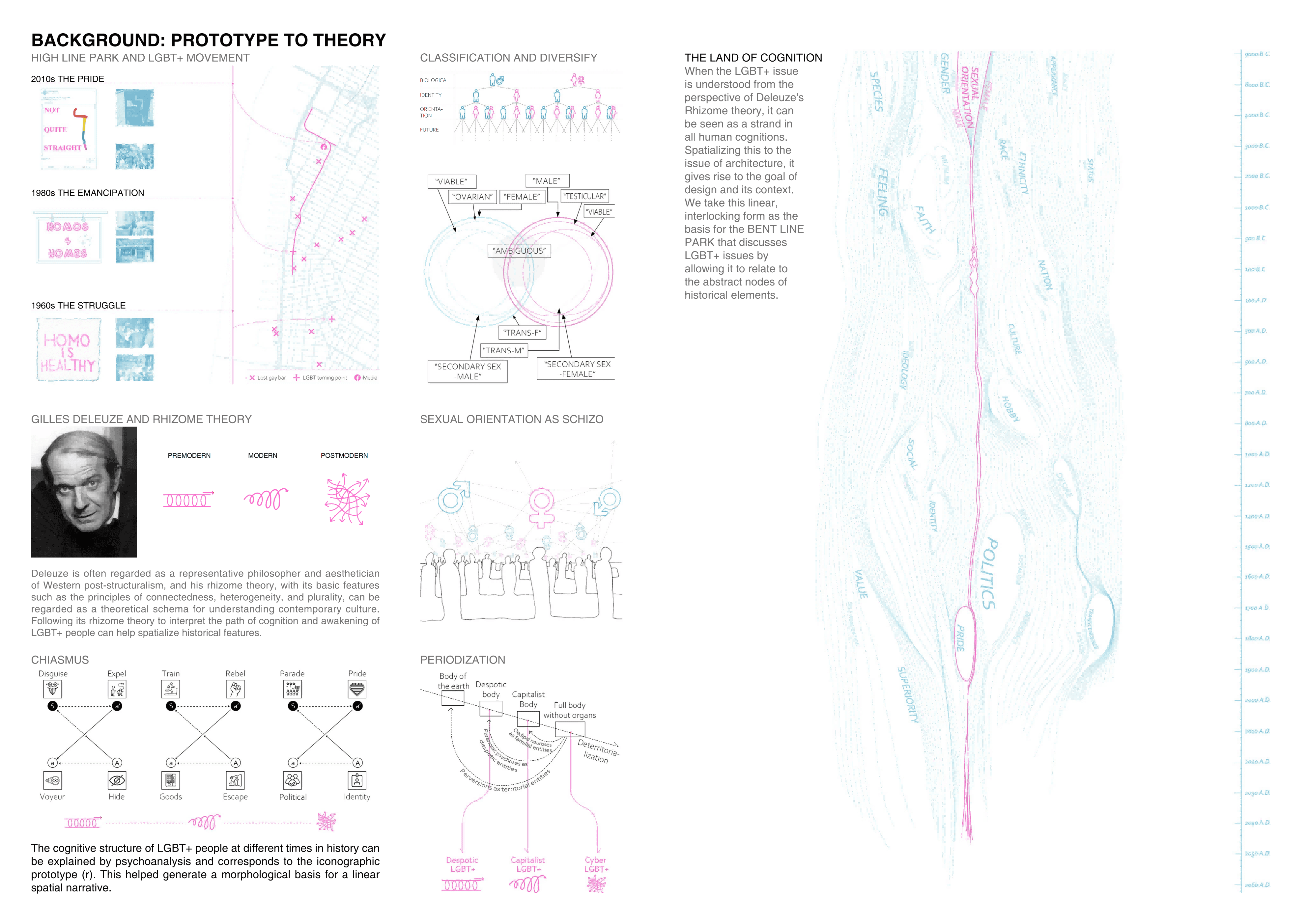
Research board documenting the theoretical foundation of the project, including mapping studies, classification systems, and the land of cognition framework. The diagrams trace the evolution of LGBT+ cognitive structures and demonstrate how rhizome theory can be spatialized through architectural intervention.
Generation History to Metaphors
03 / 07
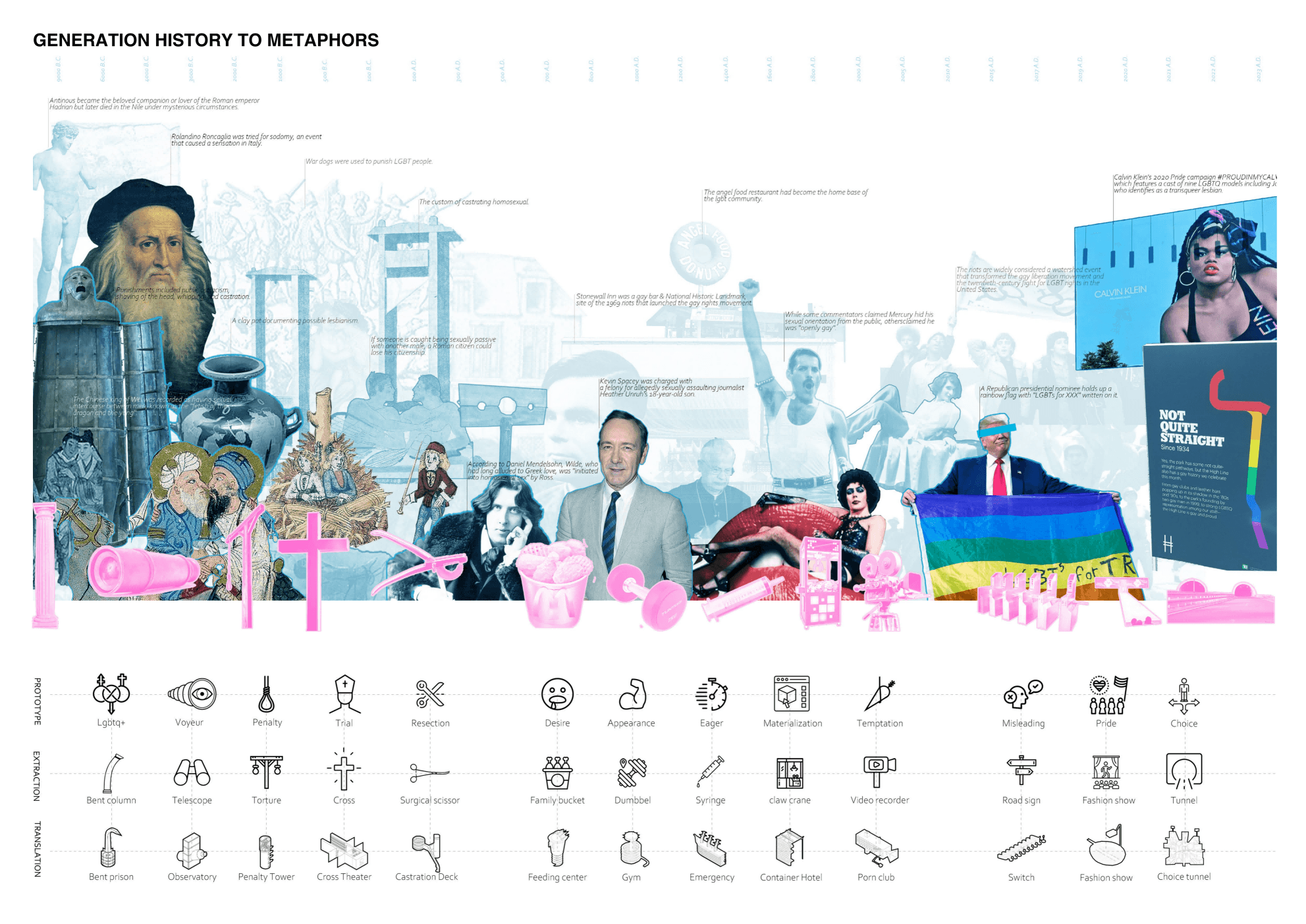
Historical timeline and iconographic analysis showing the evolution of LGBT+ representation across different eras. The collaged imagery juxtaposes religious iconography, political figures, and contemporary cultural symbols, revealing the layered narratives embedded in LGBT+ history.
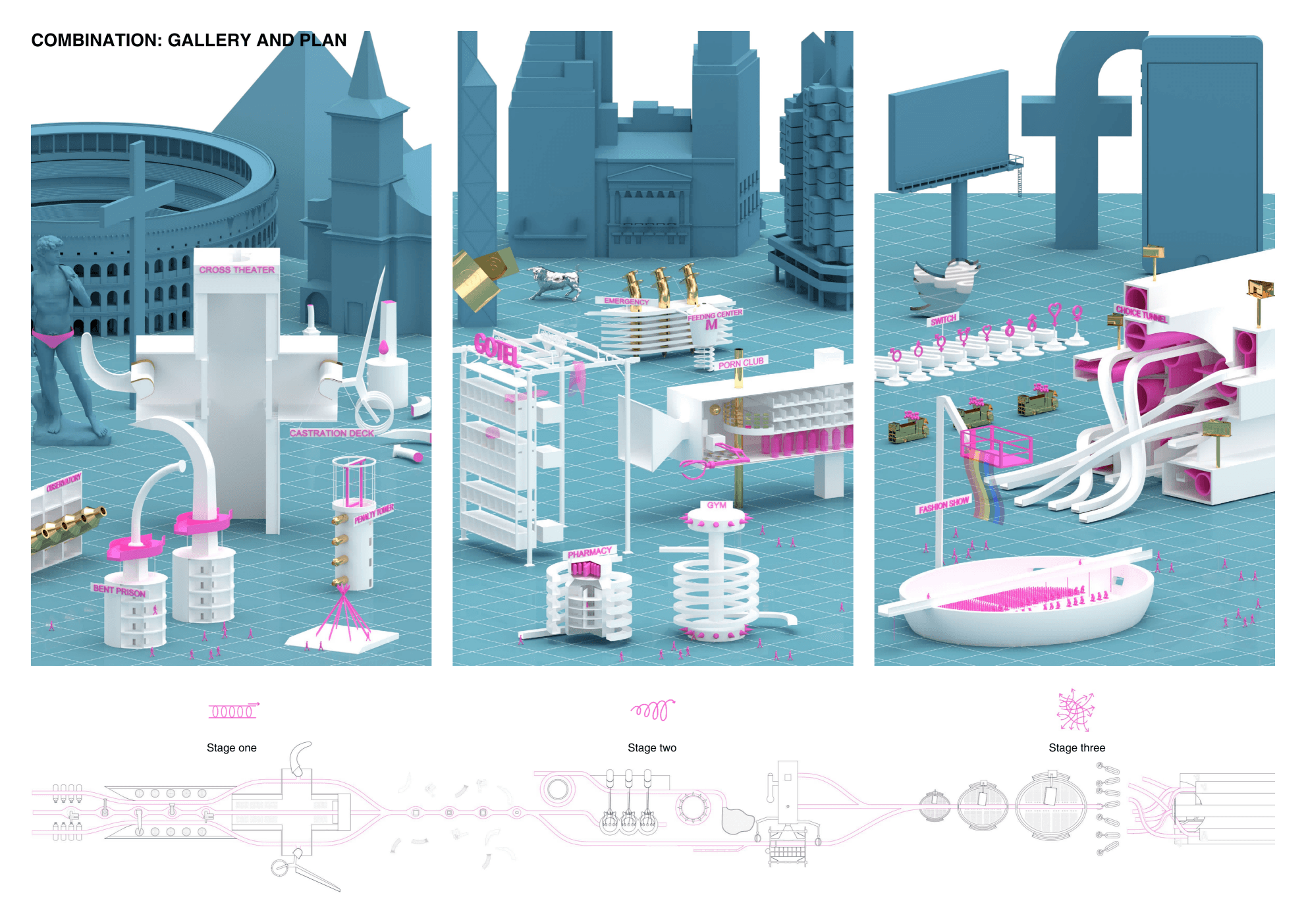
Combination: Gallery and Plan
04 / 07
Three urban vignettes showing how the Bent Line Park infrastructure creates new spatial conditions within the city. The pink pathways and platforms transform underutilized infrastructure into spaces for gathering, reflection, and narrative encounter.
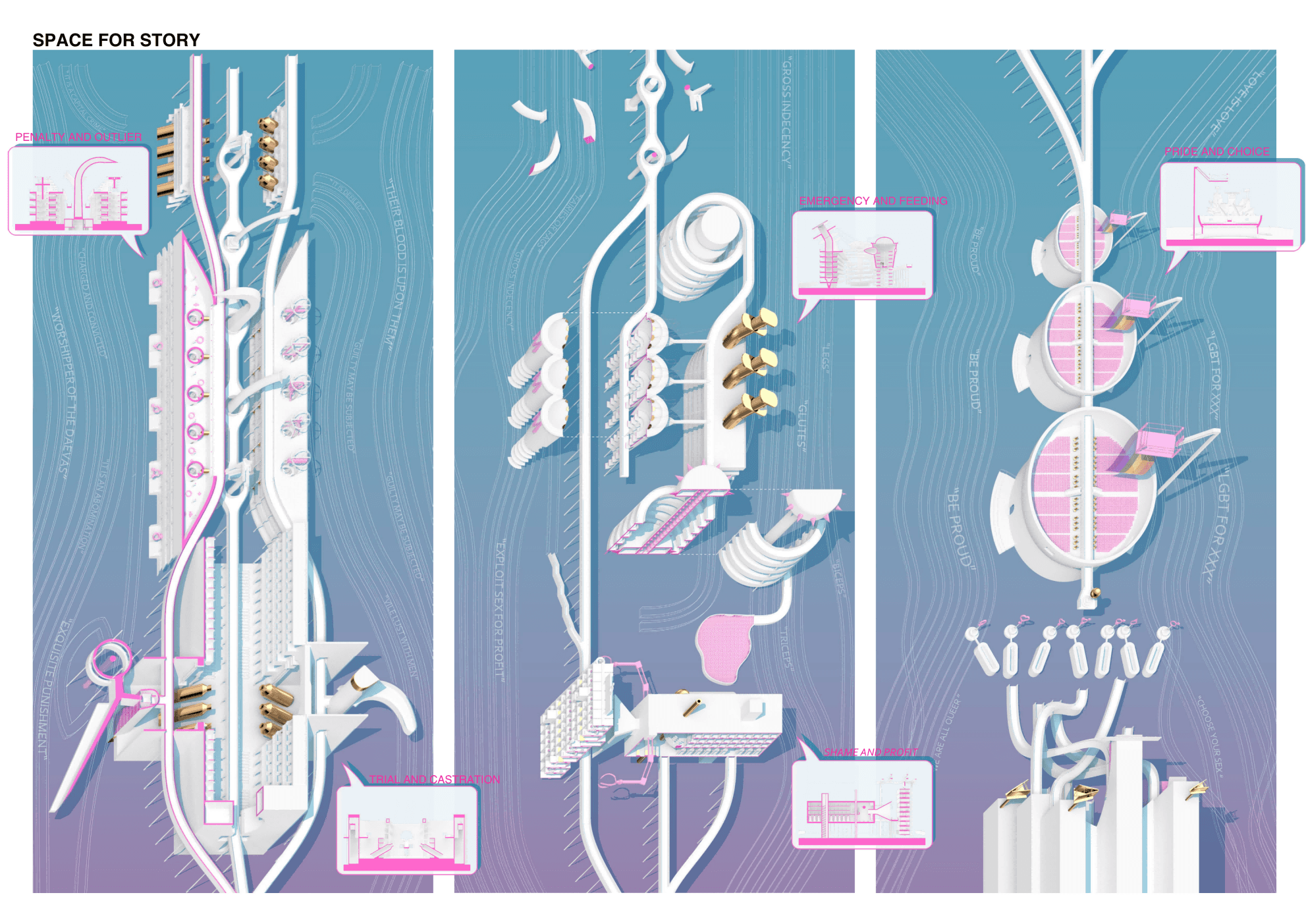
Space for Story
05 / 07
Detailed plan and elevation drawings revealing the spatial organization of narrative moments along the park. Each station along the bent line becomes a site for storytelling, where historical cognition is materialized through architectural form and programmatic curation.
Interior Perspectives
06 / 07
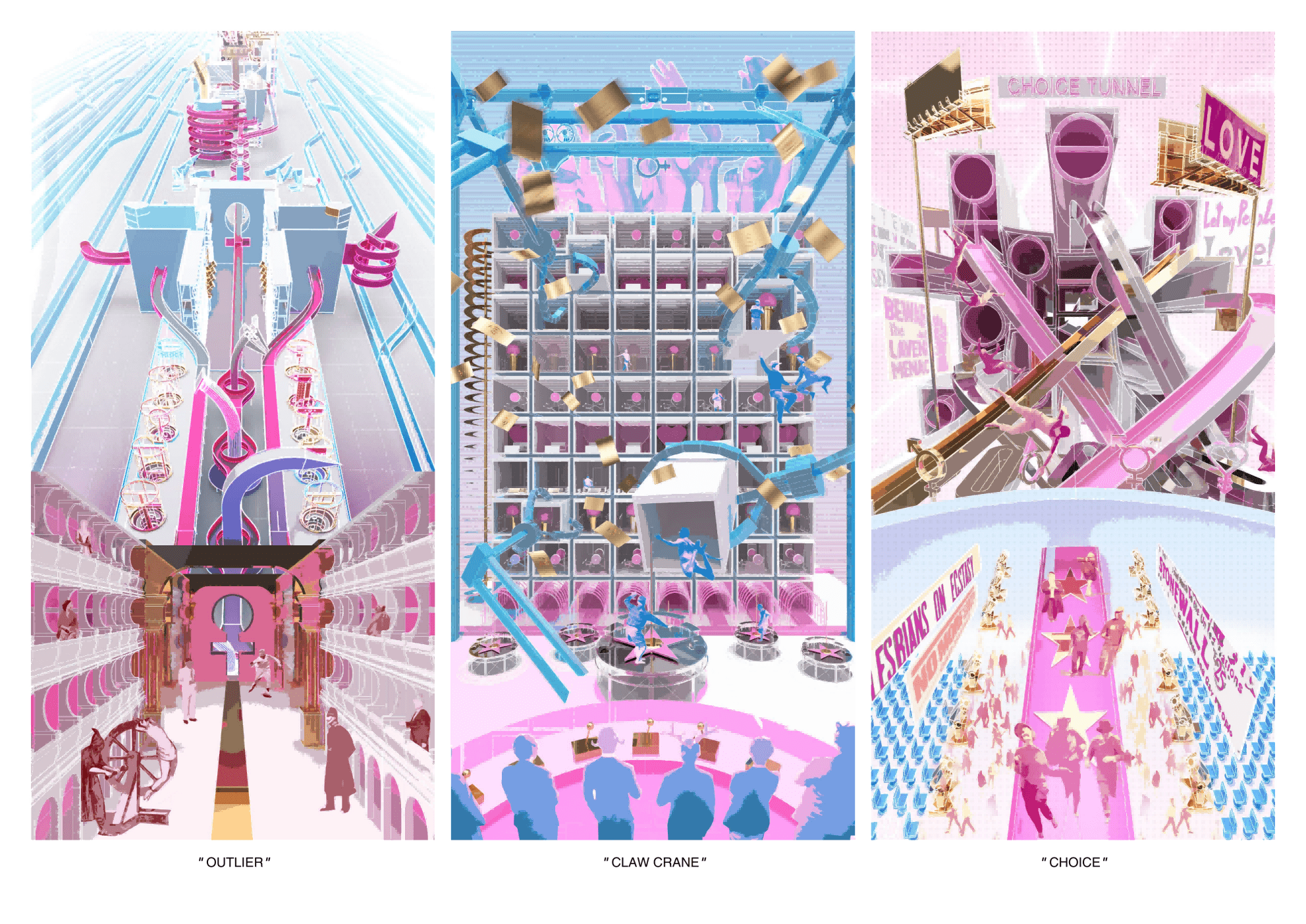
Six rendered interior views showing different spatial typologies within the park: 'Cruiser,' 'Claw Crane,' and 'Choice.' Each space creates distinct atmospheres for different modes of engagement—from contemplation to celebration, from individual reflection to collective gathering.
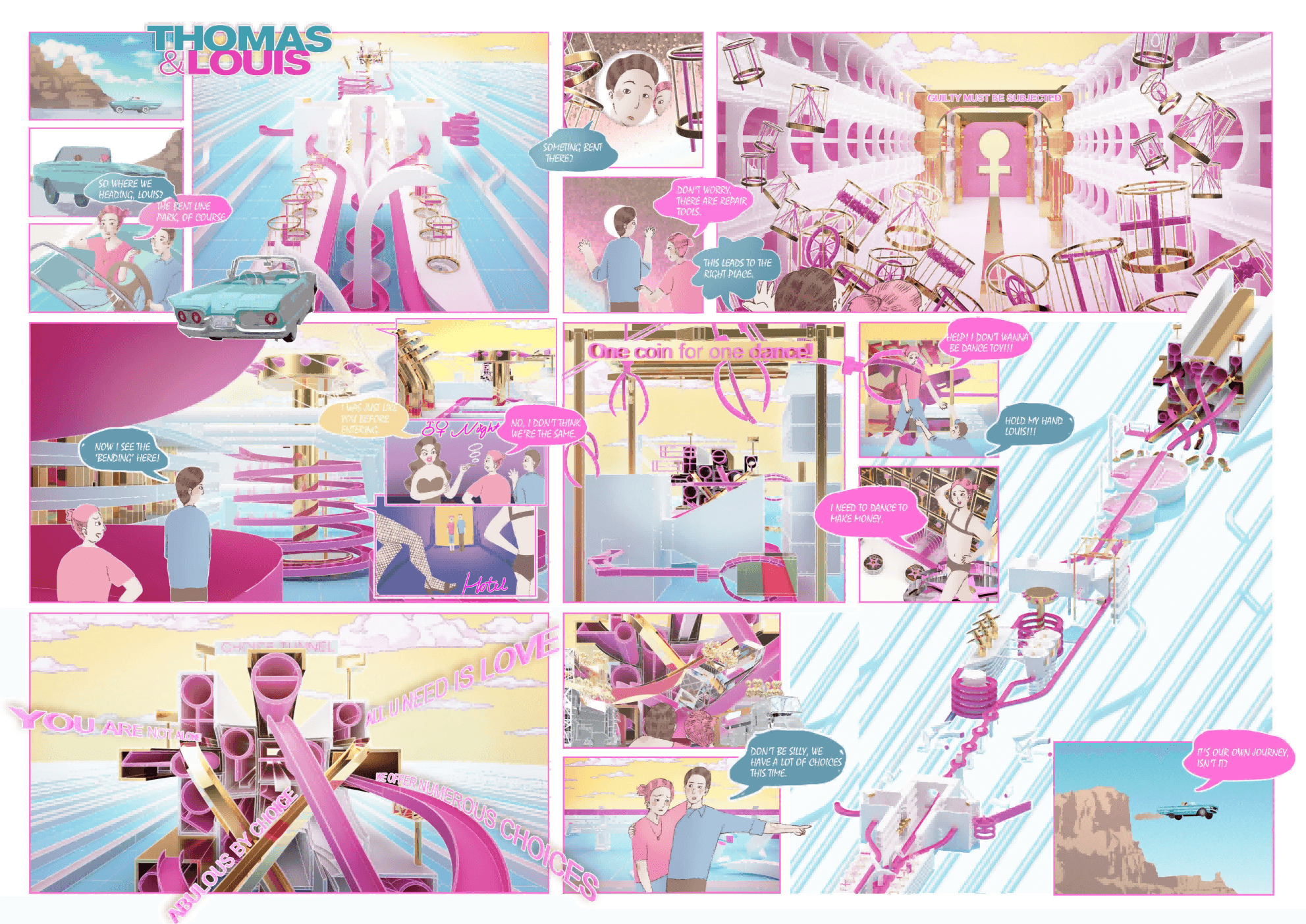
Narrative Sequence: Thomas & Louis
07 / 07
Storyboard sequence following characters Thomas and Louis through the park, demonstrating how the spatial experience unfolds as a narrative journey. The pink infrastructure becomes both backdrop and protagonist, mediating encounters between people, history, and self-awareness.
Urban Design · 2021
Bent Line Park
by Xiaofei Sun
From the psychoanalytic perspective of sexuality, the path of sexual orientation cognition is the necessary path for the awakening of the subject's sexual consciousness and the mirror stage of the human self in Donna Haraway's future anti-utopian cyborg.
Deleuze was the first philosopher to move from schizo analysis into space, but did not spatialize the schizoid sex drive schizo into a space of choice, awakening of sexuality and the subject. BENT LINE PARK addresses this gap through spatial experimentation.
Inspired by the High Line Park, the project materializes historical cognition and attitudes towards LGBT+ people, juxtaposing historical elements in multiple linear spaces for an interlaced narrative. Built on paper as an anti-utopian intervention, it serves as a spiritual commitment to thinking about human cognition and the future recognition of LGBT+ history.
Project Details
Artist
Xiaofei Sun
Year
2021
Medium
Urban Design, Spatial Research, Rhizome Theory
Dimensions
Urban design intervention
Location
Virtual
Artist Statement
Xiaofei Sun is an urban designer whose work engages with spatial theory, social history, and speculative design. Through the lens of critical theory—particularly rhizome theory and psychoanalytic frameworks—his practice investigates how architecture can materialize cognitive processes and make visible the histories of marginalized communities. BENT LINE PARK represents a commitment to design as a form of cultural scholarship and political imagination.
— Xiaofei Sun
Interested in This Work?
For inquiries or more information, please contact:
info.unbriefed@gmail.com
Works
Project Overview
01 / 07
Opening spread introducing Bent Line Park with an axonometric rendering of the vibrant pink infrastructure winding through the urban fabric. The project combines theoretical research with spatial intervention, creating a new typology that bridges history, theory, and public space.
Background & Theory
02 / 07
Research board documenting the theoretical foundation of the project, including mapping studies, classification systems, and the land of cognition framework. The diagrams trace the evolution of LGBT+ cognitive structures and demonstrate how rhizome theory can be spatialized through architectural intervention.
Generation History to Metaphors
03 / 07
Historical timeline and iconographic analysis showing the evolution of LGBT+ representation across different eras. The collaged imagery juxtaposes religious iconography, political figures, and contemporary cultural symbols, revealing the layered narratives embedded in LGBT+ history.
Combination: Gallery and Plan
04 / 07
Three urban vignettes showing how the Bent Line Park infrastructure creates new spatial conditions within the city. The pink pathways and platforms transform underutilized infrastructure into spaces for gathering, reflection, and narrative encounter.
Space for Story
05 / 07
Detailed plan and elevation drawings revealing the spatial organization of narrative moments along the park. Each station along the bent line becomes a site for storytelling, where historical cognition is materialized through architectural form and programmatic curation.
Interior Perspectives
06 / 07
Six rendered interior views showing different spatial typologies within the park: 'Cruiser,' 'Claw Crane,' and 'Choice.' Each space creates distinct atmospheres for different modes of engagement—from contemplation to celebration, from individual reflection to collective gathering.
Narrative Sequence: Thomas & Louis
07 / 07
Storyboard sequence following characters Thomas and Louis through the park, demonstrating how the spatial experience unfolds as a narrative journey. The pink infrastructure becomes both backdrop and protagonist, mediating encounters between people, history, and self-awareness.
Urban Design · 2021
Bent Line Park
by Xiaofei Sun
From the psychoanalytic perspective of sexuality, the path of sexual orientation cognition is the necessary path for the awakening of the subject's sexual consciousness and the mirror stage of the human self in Donna Haraway's future anti-utopian cyborg.
Deleuze was the first philosopher to move from schizo analysis into space, but did not spatialize the schizoid sex drive schizo into a space of choice, awakening of sexuality and the subject. BENT LINE PARK addresses this gap through spatial experimentation.
Inspired by the High Line Park, the project materializes historical cognition and attitudes towards LGBT+ people, juxtaposing historical elements in multiple linear spaces for an interlaced narrative. Built on paper as an anti-utopian intervention, it serves as a spiritual commitment to thinking about human cognition and the future recognition of LGBT+ history.
Project Details
Artist
Xiaofei Sun
Year
2021
Medium
Urban Design, Spatial Research, Rhizome Theory
Dimensions
Urban design intervention
Location
Virtual
Artist Statement
Xiaofei Sun is an urban designer whose work engages with spatial theory, social history, and speculative design. Through the lens of critical theory—particularly rhizome theory and psychoanalytic frameworks—his practice investigates how architecture can materialize cognitive processes and make visible the histories of marginalized communities. BENT LINE PARK represents a commitment to design as a form of cultural scholarship and political imagination.
— Xiaofei Sun
Interested in This Work?
For inquiries or more information, please contact:
info.unbriefed@gmail.com
Works
Project Overview
01 / 07
Opening spread introducing Bent Line Park with an axonometric rendering of the vibrant pink infrastructure winding through the urban fabric. The project combines theoretical research with spatial intervention, creating a new typology that bridges history, theory, and public space.
Background & Theory
02 / 07
Research board documenting the theoretical foundation of the project, including mapping studies, classification systems, and the land of cognition framework. The diagrams trace the evolution of LGBT+ cognitive structures and demonstrate how rhizome theory can be spatialized through architectural intervention.
Generation History to Metaphors
03 / 07
Historical timeline and iconographic analysis showing the evolution of LGBT+ representation across different eras. The collaged imagery juxtaposes religious iconography, political figures, and contemporary cultural symbols, revealing the layered narratives embedded in LGBT+ history.
Combination: Gallery and Plan
04 / 07
Three urban vignettes showing how the Bent Line Park infrastructure creates new spatial conditions within the city. The pink pathways and platforms transform underutilized infrastructure into spaces for gathering, reflection, and narrative encounter.
Space for Story
05 / 07
Detailed plan and elevation drawings revealing the spatial organization of narrative moments along the park. Each station along the bent line becomes a site for storytelling, where historical cognition is materialized through architectural form and programmatic curation.
Interior Perspectives
06 / 07
Six rendered interior views showing different spatial typologies within the park: 'Cruiser,' 'Claw Crane,' and 'Choice.' Each space creates distinct atmospheres for different modes of engagement—from contemplation to celebration, from individual reflection to collective gathering.
Narrative Sequence: Thomas & Louis
07 / 07
Storyboard sequence following characters Thomas and Louis through the park, demonstrating how the spatial experience unfolds as a narrative journey. The pink infrastructure becomes both backdrop and protagonist, mediating encounters between people, history, and self-awareness.